
[Against EW-resistant FPV drones]
A sustainable response to fiber-optic and AI-guided FPV attacks.
THE RULES HAVE CHANGED
In just three years, FPV kamikaze drones have become the dominant tactical weapon in asymmetric conflicts.
Ukraine is not the only one affected.
Iran-backed and non-state actors are deploying FPV kamikaze drones worldwide.
Established air defense fails — repeatedly.
FPV kamikaze drone strikes US military aircraft.
An Iran-backed FPV kamikaze drone struck a US military aircraft at the base near Baghdad airport for the first time — a helicopter and a Sentinel radar hit. Multiple follow-up strikes within days, no conventional air defense could intercept the Class-I platforms.
First IDF soldier killed by FPV drone.
A Hezbollah FPV kamikaze drone with fiber-optic control — structurally immune to RF jamming — struck an Israeli armored unit. 90 fiber-optic FPVs in three months against IDF positions, Iron Dome and Electronic Warfare ineffective.
First documented FPV strike on an Iron Dome position.
A Hezbollah fiber-optic FPV drone strikes an Iron Dome position in northern Israel. The IDF did not deny the strike footage published by Hezbollah; the Israeli military responded by deploying thousands of meters of fishing nets across southern Lebanon. When the world's most advanced air defense system can no longer protect itself, the asymmetry is undeniable.
How the Herakles interceptor neutralizes the threat.
Pick an attack pattern and the asset to defend — the simulation shows each run from detection to hit.
WHY EXISTING SYSTEMS FAIL
For every category we name the competing systems — with vendor claims, sources and dates.
Conventional jammers reach their limits — modern FPVs hop frequencies, and fiber-optic FPVs are increasingly adopted and structurally immune to RF jamming. And a second development is spreading: more and more FPV drones find their target in the final approach on their own, with AI on board.
Competitors and sourcesNATO ACT · DroneShield · The Fourth Law · Epirus
NATO ACT · Innovation Challenge, ACT-SACT-25-48
FindingOn fiber-optic controlled FPV drones: “EW counter-UAS systems are ineffective against this type of drone.” And: “The combination of high maneuverability, jamming immunity, and low visual and radar signature makes these drones particularly dangerous to frontline troops.”
Sources:Unmanned Airspace, 2025-05-03 (zu NATO ACT, RFIP ACT-SACT-25-48)Defense News, 2025-06-12
DroneShield · RF detection and jamming
The maker’s own statementSix months after that finding, the company’s Strategic Adviser Gus McLachlan states: “We still remain of the view that a large portion of the threat will be defeated by interrupting that RF communication between the device and the operator.”
Not statedA demonstration against a fiber-optic guided drone is not named in the published material.
The Fourth Law · TFL-1 — retrofit terminal guidance
FindingThe module “provides autonomous terminal guidance for the final 400 to 500 meters” of an FPV flight and is “built to endure heavy jamming by ignoring the radio horizon”.
Shown publicly“TFL-1 has been certified for military use by the country’s defense ministry and is now in service with roughly 20 brigades.” Not a prototype and not a concept, but certified and in service.
Sources:The Defense Post, 2025-11-19
Epirus · Leonidas — the counter-evidence we name ourselves
The maker’s own statement“The event marks the first known instance of electromagnetic interference being weaponized to defeat a fiber-optic guided drone.” Fiber optics are therefore not immune to every electronic effect.
Not statedWhat the fiber-optic guided drone was doing during the engagement is not stated in the release.
Sources:Epirus, 2026-01-13
Our readingWhat is dead is the radio link as a path to the target, not every electronic effect. High-power microwave hits the electronics rather than the link — but it is position- or vehicle-bound and works across an area, not as a point intercept of a single maneuvering target.
As of 19 Aug 2026. Quotations are verbatim from the source named. Missing information is marked as missing, not interpreted.
Conventional air defense is designed for larger platforms. FPV kamikaze drones are often too small, too fast, too agile for targeted hits. Beyond that, the systems themselves are easy to spot, draw fire and become targets for drone salvos. The arithmetic does not work out: one gun per position faces a threat that arrives in numbers.
Competitors and sourcesAllen Control Systems · ZeroMark
Allen Control Systems · Bullfrog
The maker’s own statement“Bullfrog™ is an autonomous gun turret that detects, identifies and neutralizes adversarial UAVs.” Sensors, range and target speeds are not stated on the maker’s page.
Not statedOf the Project Convergence Capstone 5 demonstration it is recorded that it was “confirming kills on all seven drone targets within range during a breach scenario”. What those seven targets flew — profile, speed, evasive behavior — appears in none of the published reports.
ZeroMark · Fire Control System
FindingThe War Zone in October 2024: “It uses an array of sensors, including electro-optical cameras and LIDAR, coupled with machine vision and advanced software algorithms, to acquire targets.”
Not statedOn the flight behavior of the targets in the 3rd Marine Division live-fire demonstration, the reporting says nothing.
Sources:The War Zone, 2024-10-24
The standard the trade press itself applies
FindingDroneXL in July 2026, on another maker’s intercept demonstration: “publish the same demonstration against truly fast aircraft. Show me the intercept timeline against a drone flying an attack profile, not a camera platform holding a line.” And: “It means the public evidence shows a kill against the easier end of the problem.”
Sources:DroneXL, 2026-07-18
Our readingWhat is in question is not the capability but the proof and the arithmetic. A turret of this class weighs close to two tonnes and faces a threat that arrives in numbers.
As of 19 Aug 2026. Quotations are verbatim from the source named. Missing information is marked as missing, not interpreted.
Designed against Class II/III long-range drones — proven against loitering munitions and larger platforms, as an alternative to a guided missile. Against Class I FPV threats at close range, the geometry breaks down: minimum airspeed and turn radius are too large for agile quad targets that exploit proximity and surprise. Additional logistical overhead: launch rails, a radar unit and pre-flight assembly make them impractical for mobile frontline force protection.
Competitors and sourcesQuantum Systems / WIY Drones · Quantum Systems · TYTAN Technologies · Anduril · Rafael / SpearUAV
Quantum Systems / WIY Drones · STRILA
The maker’s own statement“The STRILA interceptor UAV is designed to actively counter enemy wing-type UAVs, protecting positions, units, and critical infrastructure from aerial reconnaissance and attacks.”
Not statedThe brochure names fixed-wing aircraft and reconnaissance as the target class. Small, maneuvering quadcopters do not appear in the document.
Quantum Systems · Skyron 400
The maker’s own statement“Skyron 400 is a high-speed, cost-efficient interceptor UAV purpose-built to counter long-range loitering munitions like Shahed-136 drones.”
Not statedThe page claims to cover “the full spectrum of drone threats” — yet the threats it names throughout are the Shahed-136, loitering munitions and medium-altitude ISR drones. No FPV or quadcopter target class appears. The maker gives the radar detection range as up to 10 km and the take-off weight as 4.5 kg.
Sources:Quantum Systems, Skyron 400
TYTAN Technologies · TI-1 METIS and TI-2 EOS
The maker’s own statementThe TI-2 EOS is, by the maker’s own account, built for NATO Class II threats.
Not statedThe maker’s page, the system animation and the reporting all describe a layered defense against Shahed-type drones. FPV targets do not appear in any of it.
Sources:TYTAN Technologies
Anduril · Anvil
The maker’s own statementBy the maker’s own account, Anvil is aimed at Group 1 and Group 2 systems.
Our own reviewIn the system video on Anduril Industries’ own channel, published in January 2022, the interceptor hits a drone of the DJI Phantom class holding station motionless at 1:40. The same sequence runs as a loop on the maker’s website. In the text reporting, the flight behavior of the targets remains undisclosed to this day.
Sources:C4ISRNET, 2023-10-05„Anduril Lattice Counter Drone System“, Anduril Industries, 2022-01-24, 1:40
Rafael / SpearUAV · Iron Wasp
FindingEDR Magazine headlined the Eurosatory 2026 presentation “Rafael and SpearUAV virtually launch the Iron Wasp C-UAS effector” and writes: “Although not present in mock-up form, Israel unveiled the Iron Wasp”. France had imposed restrictions on Israeli stands. A live demonstration for international customers was planned at that point, not held.
Our own reviewThe announcement video on Rafael’s own channel, published on 16 June 2026, shows an animated concept throughout. It contains no live footage of an intercept.
Sources:EDR Magazine, 2026-06-25Israel Defense, 2026-06-22„Just Launched: IRON WASP C-UAS“, RAFAEL Advanced Defense Systems, 2026-06-16
Our readingWherever the target class is named at all, it is the Shahed and reconnaissance domain — not the small, maneuvering quadcopter at close range.
As of 19 Aug 2026. Quotations are verbatim from the source named. Missing information is marked as missing, not interpreted.
The systems common across the industry sit on large, sluggish carrier platforms and are built against the previous threat generation: slow, often hovering Mavic-class camera drones. Against an agile, fast-maneuvering target the capture comes too late. And every intercept attempt ties up an entire platform — the threat comes in numbers, the countermeasure does not.
Competitors and sourcesARGUS Interception · Fortem Technologies · Alpine Eagle
ARGUS Interception · A1-Falke
The maker’s own statementThe stated purpose is the “controlled interception and secure recovery of uncooperative drones”; the system “brings them to the ground intact, enabling forensic evaluation and preservation of evidence”. The effector carries radar, LiDAR and a depth-sensing camera.
Our own reviewIn a public press demonstration filmed by euronews in June 2026, a near-motionless Holybro X500 V2 is captured — an open development quadcopter, not a threat representative airframe. The same scene runs as a loop on the maker’s landing page.
Sources:ARGUS Interceptioneuronews (deutsch), „Mit Radar und Fangnetz“, 2026-06-01, 0:23
Fortem Technologies · DroneHunter F700
The maker’s own statement“Utilizing its onboard TrueView® R20 radar, the F700 detects, tracks, and locks onto its target with conviction.” Capture is by net: a tether net against Group-1 drones, and “DrogueNet™, a device that disables large Group-2 drones”.
Not statedTarget speeds are not stated on the product page. For the more than 4,500 captures claimed, not one drone type is named.
Alpine Eagle · Sentinel
Finding“Sentinel combines Alpine Eagle’s airborne radar and sensor network with a software-defined defence architecture to detect and track hostile drones across wide areas and defeat them with onboard airborne interceptors.”
Not statedTarget classes, FPV suitability and the flight behavior of targets in the trials are not stated in the published material.
Sources:European Security & Defence, 2026-03-19Alpine Eagle, Sentinel
Our readingA capture needs an approach phase and a target that allows one. Where the stated design intent is intact recovery for evidence, it is not the interception of an incoming weapon.
As of 19 Aug 2026. Quotations are verbatim from the source named. Missing information is marked as missing, not interpreted.
Promising complementary capabilities, but vehicle- or platform-bound and extremely power-intensive. Lasers are additionally constrained by atmospheric conditions (fog, rain, dust) and require dwell time per target: for that duration the beam has to stay on the exact same spot of the target — barely achievable against a fast-maneuvering FPV. On top of that, their size and platform binding make them easy to spot, and they become targets for drone salvos. What each position demands in power and platform cannot be multiplied at the pace the threat multiplies.
Competitors and sourcesINLEAP Photonics · Epirus
INLEAP Photonics · FASTLIGHT SHIELD
The maker’s own statement“The laser beam can be steered up to 2500 times faster than with conventional beam steering systems.” Target class and engagement time are not stated on the maker’s page.
Our own reviewTwo television documentaries show the same footage — ntv in July 2026 and RTL Nord in August 2026: a DJI Mini 3 hovering motionless roughly three meters above the ground is defeated after several seconds of continuous irradiation of the same spot. The effector sits on a trailer.
Sources:INLEAP Photonicsntv nachrichten, 2026-07-14, 0:27RTL Nord, 2026-08-03, 3:13
Epirus · Leonidas
The maker’s own statement61 of 61 drones in a live-fire demonstration, described by the maker as flying “operationally relevant flight scenarios”.
Not statedWhether the targets evaded or maneuvered is not stated in the release. The effect is an area effect against swarms, not a point intercept of a single target.
Sources:Epirus, 2025-09-10
What the physics demands
FindingPeer-reviewed: “The laser technique is affected by adverse weather conditions, such as fog, rain, and cloud.” And: “Drones are usually fast and agile, so destroying them should require a short time and high energy.” The effect is proportional to power and to time on target.
Sources:Chaari & Al-Maadeed, Security and Defence Quarterly 32(5), 2020
Our readingDwell time is not a side condition, it is the arithmetic itself: the beam has to stay on the same spot of the target for seconds. What the published demonstrations put against it is a target that holds still.
As of 19 Aug 2026. Quotations are verbatim from the source named. Missing information is marked as missing, not interpreted.
ARCHITECTURE PRINCIPLE
THE ANSWER: DRONE VS. DRONE.
Radically reduced by design.
An autonomous drone that intercepts FPV drones. It launches vertically from a standing start — no vehicle, no ramp, no command post — and works by pure collision, without a warhead. Designed against a target that evades, can't be jammed, and comes in numbers:
Built like its target
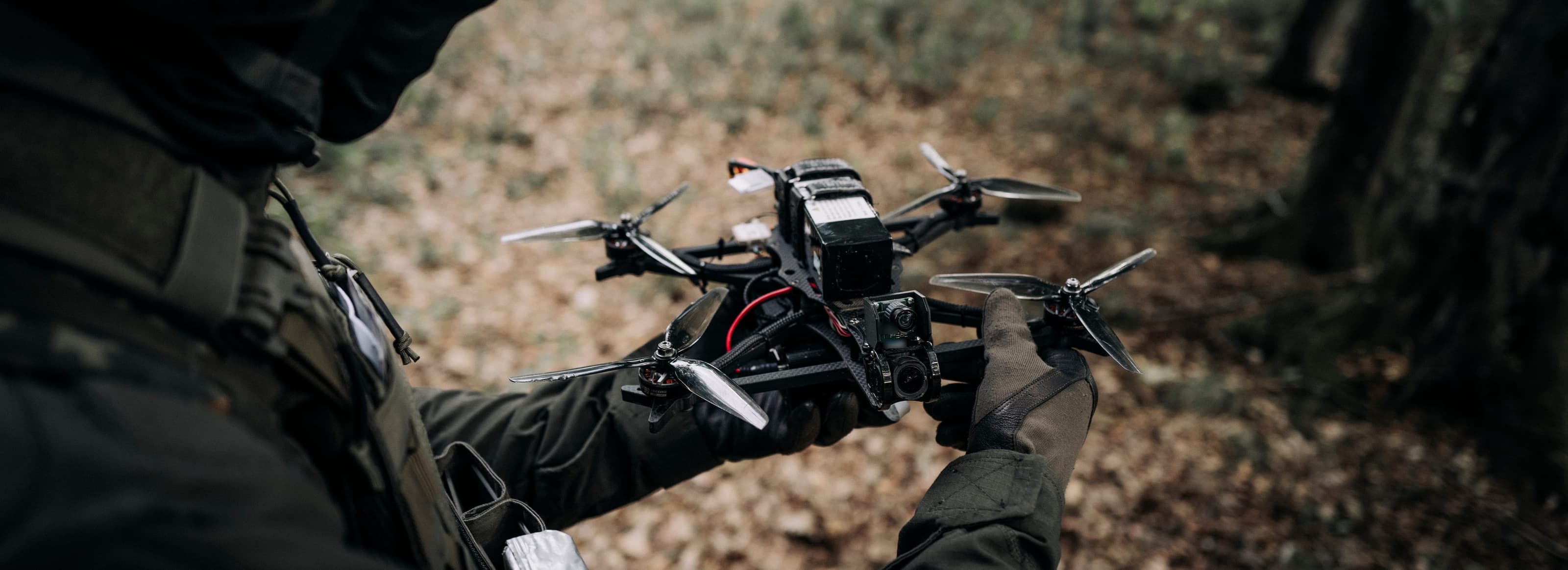
An FPV drone dodges, changes direction by the second and flies low. Catching it takes the same agility. So we use the same racing airframe the adversary uses — except ours carries no warhead and flies autonomously. Less mass, more margin: our interceptor dictates the maneuver, not the attacker.
Works where jammers stop
The standard answer to a drone is to break its radio link. Fiber optics and onboard AI in the final approach have retired that answer. Our interceptor never goes after the link at all: it sees its target and flies at it — no radio, no GPS.
Affordable in numbers
This threat arrives in vast numbers. A defense that costs many times the attack does not add up. Because our interceptor does without expensive sensing and without explosive payload, it protects lives and assets worth millions at the price of the attack.
COMPLIANCE & SYSTEM FRAME
Deployment Contexts
Bundeswehr & NATO Forces
Infantry and convoy protection at tactical close range. Vertical Takeoff, infantry-deployable, kinetic effector under Operator-Authorization.
EU Allied Forces
Counter-UAS layer for armed forces facing active Class I FPV threats. Established defense validation channels. ITAR-free; dual-use across defense and critical infrastructure.
Critical Infrastructure (DE/EU)
Airports, energy infrastructure, ports, major events. Detection-first mode; kinetic deployment exclusively via an authorized state operator.
FROM SIM TO INTERCEPT.
[ SIM ]
In-house simulation environment with full flight dynamics, calibrated sensor-noise models and parameterized threat profiles. Batch-evaluation across thousands of engagement scenarios against evasive, accelerating and sensor-noisy targets. Identical code path between simulation and flight hardware closes the classic sim-to-real gap.
[ BENCH ]
Standardized bench routines for every hardware iteration: powertrain characterization, sensor calibration, failsafe verification and authorization logic under realistic load profiles. Automated regression tests safeguard function and safety before any field deployment.
[ REAL-FLIGHT ]
Fully autonomous intercept of an inbound, actively maneuvering FPV threat under operator authorization, flown as a controlled trial — acquisition, tracking and intercept course computed on board, without GPS, without a rangefinder and without a radio link.