

Autonomous · GPS-denied ·
Vertical Takeoff · Software-Defined.
Tested and proven. Fully autonomous intercept of maneuvering FPV drones.
Autonomous mass. Frontlines protected.
DESIGNED BACKWARD FROM THE THREAT.
We built against the hardest case from day one: the actively maneuvering, fiber-optic-guided FPV drone.
Engineering Thesis
Existing counter-UAS architectures were designed against different threats. Three of their founding assumptions no longer hold against today's FPV drones: that the threat can be jammed, that it flies slowly and on a predictable trajectory, that cost parity is irrelevant. Herakles is not a cheaper alternative to a guided missile — we address an entirely different threat profile.
Re-Definition
What does it actually take to stop Class I FPV drones reliably and at scale? A platform that matches the threat physically at close range. Sensing and state estimation that hold up under electronic warfare. Unit costs that scale with the threat. An architecture follows.
PORTABLE, COST-EFFECTIVE PROTECTION AGAINST COORDINATED FPV ATTACKS.
Four decisions carry this architecture. Each had to pass the same test: does it hold against a target that evades, doesn't transmit, and arrives in numbers?
Software-Defined
Our interceptor needs nothing more than a fixed-mounted camera and an IMU. No external radar cueing, no LiDAR, no stereo cameras, no gimbal. Our guidance works without depth estimation. Neither target acquisition nor trajectory depends on GNSS or on a radio link. This radically reduced hardware stack scales with the threat.
Quad-Native Guidance
Conventional long-range interceptor systems force drone hardware into missile-like geometries so classical guided-missile algorithms will run on them. We went the other way and built our guidance natively around the racing airframes that make offensive FPV drones so dangerous today.
That is what makes the strengths of the quad geometry usable: attitude changes in milliseconds, hover, sub-second response against evasive targets.
No Infrastructure
Herakles needs no ramp, no launcher, no vehicle, no command post, no calibration.
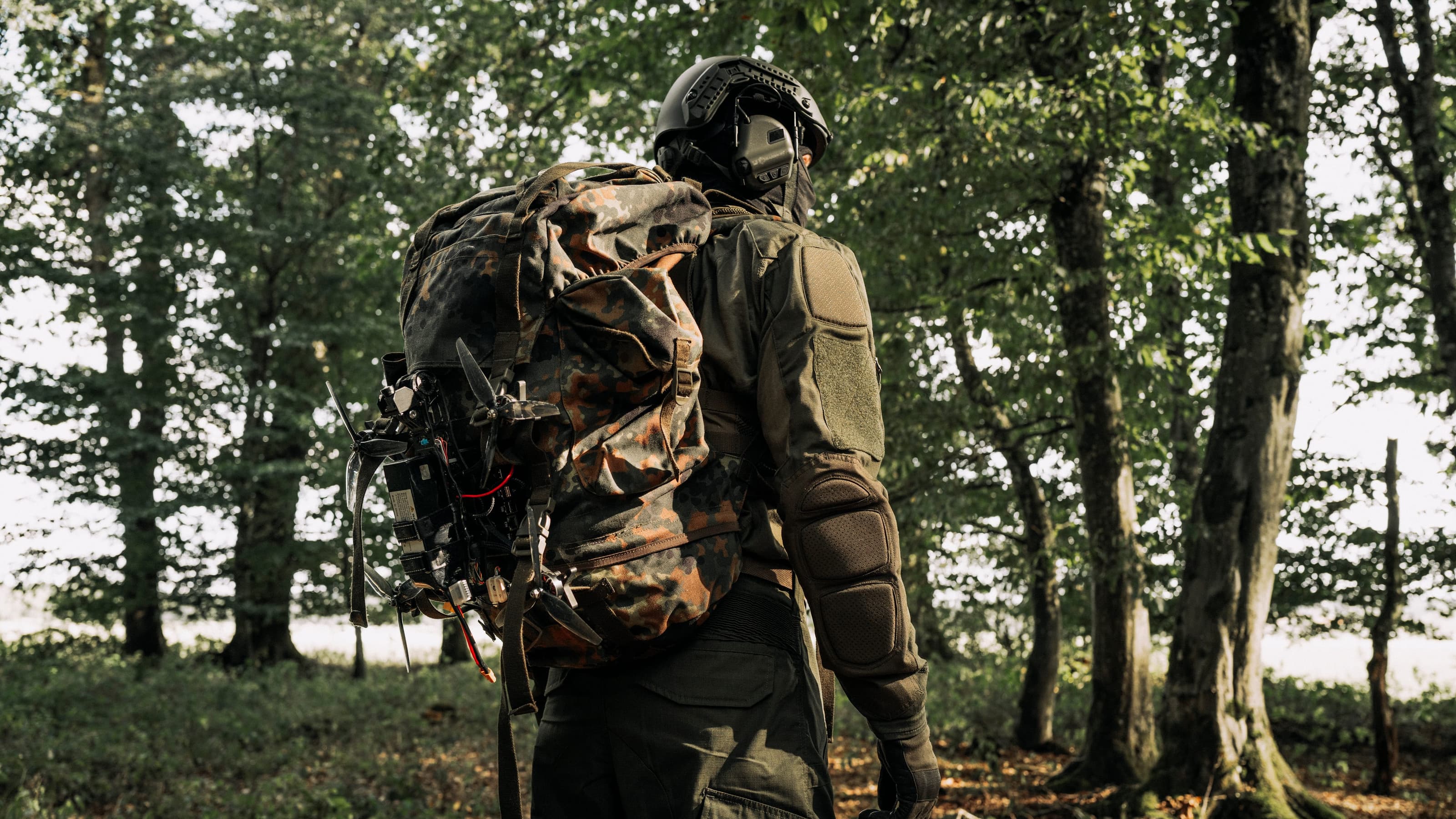
Out of the backpack, straight up from the ground or from the hand, ready in seconds. One person, one system, one takeoff.
Raptor-1 is detection and effector in one.
Cost Parity by Design
For us, cost parity was a design constraint. It came first and shaped every decision after it: no exotic sensing, no explosive warhead, no custom manufacturing — instead a drivetrain from the same ecosystem that produces the FPV threat itself.
Defend at a higher cost than the adversary attacks, and you lose the war of attrition.
A THOUSAND INTERCEPTS BEFORE THE FIRST.
Digital twin, built in-house.
Our simulation is built around the flight physics of FPV quads: it runs the same control code as the flight hardware, its physics are measured on the actual airframe, its disturbances are fitted from real flight logs. Before any real test flight, an interceptor has already flown thousands of times in there.
Coverage
In simulation we model thousands of engagement scenarios: different approach directions, evasive maneuvers and sensor disturbances, deterministic and evaluated overnight. That is how the guidance gets improved and how we narrow down what makes an intercept fail.
Fed by every flight
Every real flight is replayed back through the model. Where model and reality diverge, we correct the model — not the expectation. That is how defects were found before they ever flew, and how failure signatures observed in flight were reproduced in the model until the cause was established. Predictions from the simulation have since been confirmed in flight.
What compounds
Measured physics, disturbance models fitted from flight data, reproduced failure modes: none of it appears on a bill of materials, and none of it can be rebuilt from one. It is the part of the system that grows with every flight.
INTERCEPTOR ANATOMY.
THREE-PHASE DEFENSE.
Detection wakes the interceptor from standby and raises an alarm with the operator.
Operator-Authorization gates takeoff. Post-launch the system operates autonomously in the terminal phase. Disengage-Override is available to the operator at all times.
Vision-based guidance with onboard state estimation. Kinetic collision as effector mechanism, no warhead against personnel or infrastructure.
VALIDATION STATUS.
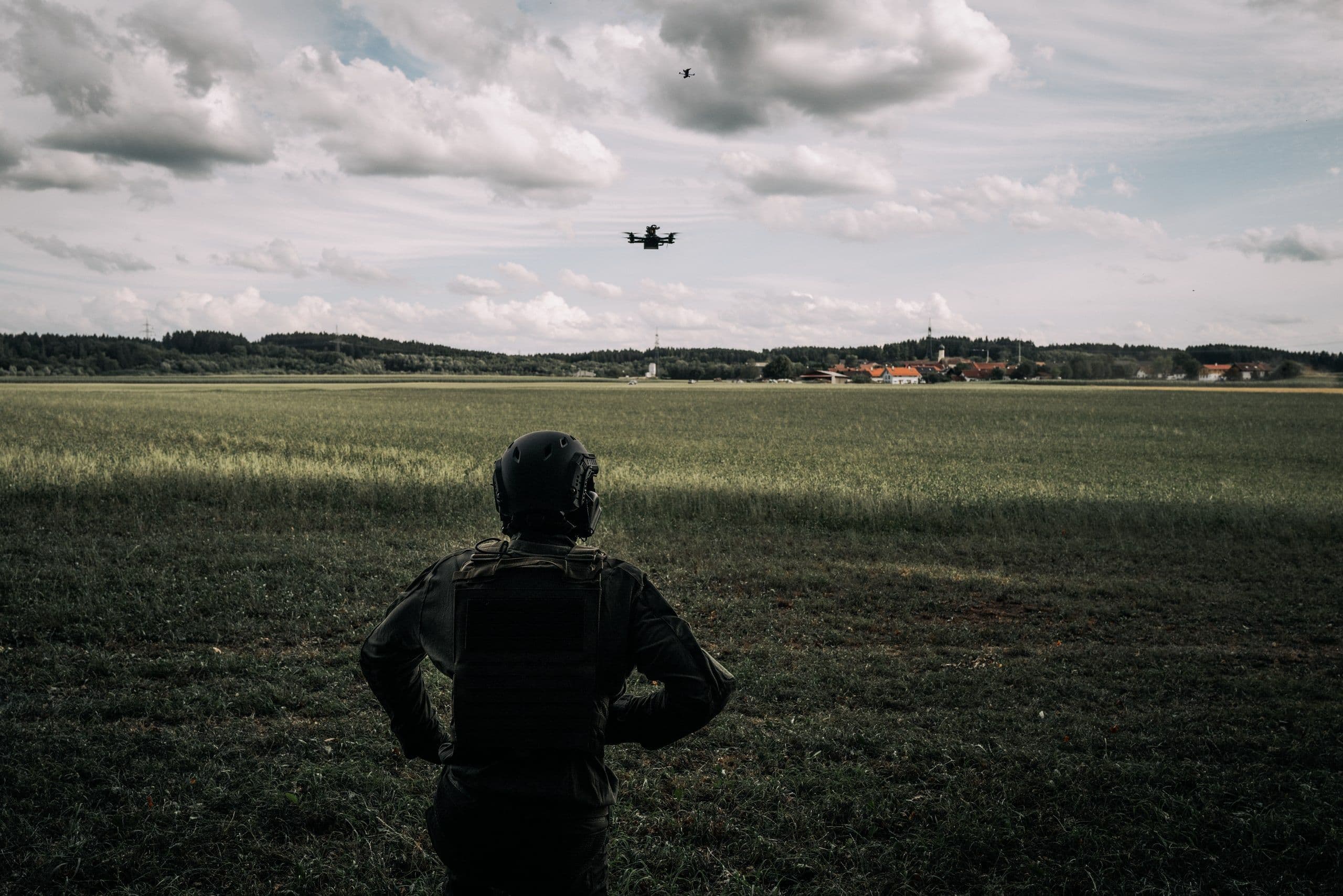
Demonstrated fully autonomous intercept of agile, EW-resistant drones.
Fiber-optic-controlled 10-inch FPVs built to common industry standard, carrying a simulated mockup explosive payload, 60–80 km/h attack speed, manually piloted.
After the operator's release, tracking and intercept-course computation run entirely on board.
No GPS, no radio link, no depth estimation.
Real flight data flows directly back into simulation and bench.
Reproduced multiple times and documented on video. Under NDA: the log of every intercept attempt; the cue-to-impact timeline; bill of materials; raw footage.
TRL 5 — Advanced MVP stage
Repeatedly validated in a relevant environment. Next steps: repetition at scale, testing at night and in adverse weather, extended visual detection range, integration of acoustic early detection via partner or in-house development, third-party confirmation.
Real-Hardware-Validated. Pre-Seed Round open.
Engineering briefings available under NDA.